The Great Sensory Race: Hearing & Sensation. – Free Quiz Game Worksheet for College
quiz-game: The Great Sensory Race: Hearing & Sensation. — play it online or print it for the classroom.
About this resource
Activity type: Quiz Game. Topic: Sensation. Grade level: College. Language: English. Free to print and free to play online, with no student sign-up required.
What's in this quiz game
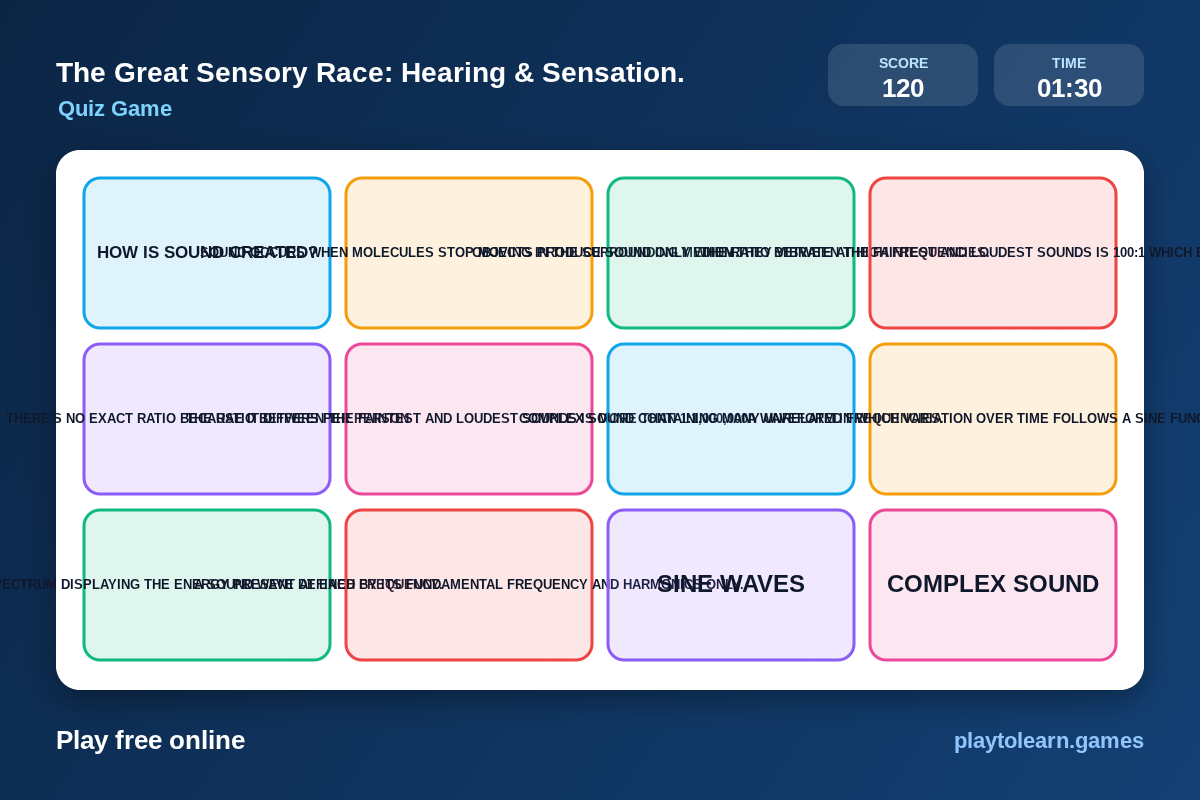
How is sound created? · Sound occurs when molecules stop moving in the surrounding medium. · Objects produce sound only when they vibrate at high frequencies. · The ratio between the faintest and loudest sounds is 100:1 which equals 40dB · There's no exact ratio because it differs per person · The ratio between the faintest and loudest sounds is more than 1:1,000,000. · complex sound containing many unrelated frequencies. · A waveform in which variation over time follows a sine function. · A spectrum displaying the energy present at each frequency. · A sound wave defined by its fundamental frequency and harmonics only. · Sine waves · Complex sound · Basic sound · Timbre harmonic sound · Pinnea · Ear canal · The tympanic membrane · The malleus · True · False · The structure of the middle ear consists of the ______ and ______. · The cochlea is composed of 3 fluid-filled ducts. What are they? · Scala Vestibuli, Scala Media, Scala Tympani · Semicircular Canals, Cochlear Duct, Auditory Canal · Oval Window, Round Window, Scala Media · Scala Vestibuli, Eustachian Tube, Scala Tympani · Which structure is sensitive to temporal differences when localizing sound? · LSO · MSO · Inferior colliculus · Medial geniculate nucleus · Superior olive · Auditory cortex · Superior colliculus · Where do the first stages of auditory processing begin? · Frontal lobe · Temporal lobe, within areas of the Sylvian fissure · Occipital lobe · Parietal lobe · The audibility threshold represents:
Print it or play it online
This quiz game prints as a clean worksheet with an answer key, and also runs in any browser so students can play on a laptop, tablet, or Chromebook. It is free to use and free to copy for your own class.
Make your own quiz game
Use the generator to build the same activity with your own word list, then sign in free to save within your Library allowance. Creation, AI and print/export allowances vary by plan. Students can play shared games without an account.
Keywords
quiz game · play online · interactive game · online game · Sensation · College
Frequently asked questions
Is The Great Sensory Race: Hearing & Sensation. free to use?
Yes. The Great Sensory Race: Hearing & Sensation. is available with free access, subject to plan allowances. Creation, AI, Library storage and print/export allowances vary by plan; compare them at /pro#plan-comparison. Students can play shared games without an account.
Can students play The Great Sensory Race: Hearing & Sensation. online?
Yes. It runs in any browser, so students can play on a laptop, tablet, Chromebook, or a classroom projector — no install and no sign-up.
What words are included in The Great Sensory Race: Hearing & Sensation.?
It covers How is sound created?, Sound occurs when molecules stop moving in the surrounding medium., Objects produce sound only when they vibrate at high frequencies., The ratio between the faintest and loudest sounds is 100:1 which equals 40dB, There's no exact ratio because it differs per person, The ratio between the faintest and loudest sounds is more than 1:1,000,000., complex sound containing many unrelated frequencies., A waveform in which variation over time follows a sine function., A spectrum displaying the energy present at each frequency., A sound wave defined by its fundamental frequency and harmonics only., Sine waves, Complex sound, Basic sound, Timbre harmonic sound, Pinnea, and more.